
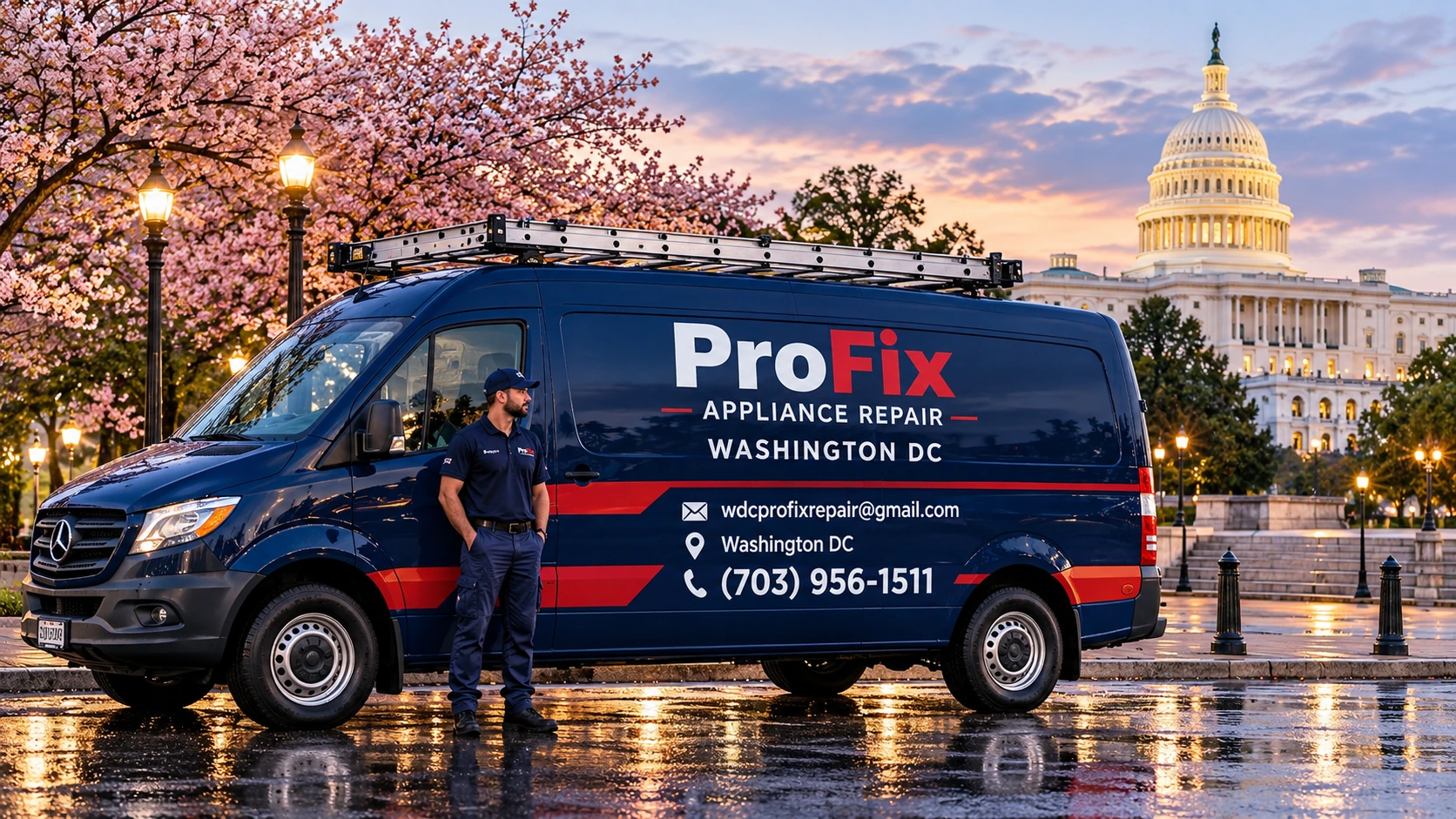
Oven · All brands
Oven Repair in Washington, DC
Oven repair in your home, condo or rental anywhere in DC, for every major brand. Same-day visits when the schedule allows.
Or book online and we'll get back to you to set a visit window.
Schedule Your Repair
Four quick steps. We'll confirm a visit window with you, and you'll get a written estimate before any work starts.
Service Type
What type of service do you need?
Or call us directly:
(703) 956-1511Oven Brands We Repair































Repair Planned Around How Homes Here Are Built
WDC ProFix Repair fixes ovens and ranges in rowhouses, apartments and detached homes in all four quadrants of the District. The technician tracks down the fault where the appliance stands, writes up the repair and the price for your approval, and finishes on the spot when the part is on hand. We work on Samsung, LG, Whirlpool, GE, Maytag, Bosch and the other brands listed below. We're an independent repair company, so if your oven is still under the manufacturer's warranty, contact the manufacturer first. Repairs carry a 90-day parts and 30-day labor warranty.
How It Works
Washington, DC · Arlington · Alexandria
Ready to schedule your repair?
WDC ProFix Repair: independent, in-home appliance repair with a written estimate before any work starts.
What Lives Inside the Oven Cavity
This guide is about the insulated box where you bake and roast, whether it sits under a range top, stands alone as a single wall oven, or is one half of a double wall oven. Burner problems on top belong to the stove and cooktop guides; this one stays inside the door.
Every oven runs a simple loop. You set a temperature, a sensor probe on the back wall reports what the cavity actually reads, and the control turns heat on and off to close the difference. Electric ovens heat with a bake element along the bottom and a broil element along the top. Gas ovens use a bake burner below the floor panel and often a separate broil burner up top, each lit by a glowing igniter. Convection models add a fan in the back wall, sometimes with its own ring-shaped element, to keep air moving so food browns evenly on every rack.
When Baking Goes Wrong: Possible Causes
An oven that never gets hot, or takes far too long to preheat, may have a burned-out element, a weak gas igniter or a failed temperature sensor. A gas igniter can look bright and still be the culprit: the valve opens only when the igniter passes a certain current, and a tired igniter may glow without ever getting there.
Cakes that burn on the bottom and stay pale on top often point to a broil element that has quit, since many ovens use both elements during preheat. Temperatures that drift well above or below the setting suggest a sensor that has wandered out of range or a door gasket that lets heat escape. A convection setting that cooks no differently from regular bake may mean the fan motor has stopped.
If the oven will not turn on at all, the cause could be a tripped breaker, a blown thermal fuse, a failed relay on the control board or, on a wall oven, a loose connection in the junction box behind the unit. A display that flashes an error code is the oven telling you which circuit it distrusts.
Self-Clean, Door Locks and Wall Oven Quirks
No recipe comes close to the heat of a self-clean cycle, and parts feel it. It is one of the most common moments for a thermal fuse to blow, a door lock motor to jam or a control board to fail. An oven stuck locked after a clean cycle usually needs the cavity to cool fully before anything else; if it still will not release, the lock assembly or its switch is a likely suspect.
Wall ovens have their own patterns. Electronics sit above the cavity in a tight space, so heat from a cooling fan that has stopped can damage the control. In a double wall oven, the upper and lower cavities share a board and a cooling system, which is why a fault can sometimes affect both at once. Getting at those parts often means sliding the unit partway out of the cabinet, a job best done by a technician because it is heavy and wired directly into the house.
Smells, Smoke and Odd Noises From the Oven
A burning smell the first few times a new oven runs is normal, as factory coatings bake off. After that, smoke usually comes from food residue on the floor or the elements. A sharp electrical smell is different and can mean wiring near an element terminal is overheating; turn the oven off and leave it off.
Gas ovens make a soft whoosh when the burner lights, and a short delay after the igniter starts glowing is expected. A loud bang at ignition, a delay that keeps getting longer, or a flame that lifts off the burner suggests the igniter or the burner needs attention. Convection ovens hum from the fan, but grinding or squealing often means its bearings are wearing out. Cooling fans on wall ovens can also rattle as they age, and since they protect the electronics, a noisy one is worth having checked before it stops altogether.
The Order a Technician Tests In
First, the technician confirms supply: the right voltage at the terminal block, or steady gas pressure to the valve. Then they run the oven and watch which heat source comes on and which does not. Elements get checked with a meter for resistance. A gas igniter's current draw is measured rather than judged by its glow.
Next comes the temperature sensor, whose resistance should match the cavity temperature. After that, the technician checks the door gasket and hinges, then the lock, fans and fuses. The control board comes last, after its inputs and outputs are proven, since boards are expensive to guess at. You get the written estimate before any part is ordered.
Simple Owner Checks Before You Book
Look at the breaker panel for a tripped oven breaker, especially for a wall oven, which usually has its own double breaker. Make sure the clock is set, because some models will not heat until it is. Check that a delay-start or Sabbath mode has not been switched on by accident.
With the oven off and cool, look at the exposed elements for blisters, cracks or a broken section. Run your fingers along the door seal; if it is flattened, torn or loose in spots, it may be letting heat escape. A cheap oven thermometer on the middle rack will tell you whether the temperature is really off before anyone opens a panel. Any whiff of gas changes the plan: get out, leave every switch as it is, and phone Washington Gas or 911 after you are clear of the house.
District Kitchens and the Oven
Wall ovens show up often in renovated Washington houses, from detached homes in Chevy Chase DC and Spring Valley to gut-renovated rowhouses on the Hill. When a kitchen is opened up and modernized, the oven is frequently built into a tall cabinet with little room around it, and heat management depends on the original installation instructions being followed. An oven pushed into a cabinet that is too snug may run its cooling fan constantly and wear out its controls early.
Summer storms are another local factor. A thunderstorm that drops and restores power in quick succession can leave an electronic oven control locked, blank or showing a fault. Switching off the oven's breaker for a minute often clears it. If it does not, the board or a relay may have taken a hit.
In older gas homes on Washington Gas, the oven's bake burner shares its supply with the burners above. If the oven is part of a range that has been moved for a floor refinish or cabinet work, the connector behind it may have been stressed, so mention any recent move when you book.
Repairing or Replacing an Oven
Elements, igniters, sensors, fuses and door gaskets are straightforward replacements, and on an oven with a healthy cavity they are nearly always worth doing. The harder decision tends to come with a failed control board on an older model, where the part may be costly or no longer made, or with rust or cracked enamel inside the cavity.
Built-in wall ovens tilt the math toward repair, since a replacement has to match the cutout exactly or the cabinetry changes too. The technician will tell you what failed, whether parts are still available, and what condition the rest of the oven is in.
Keeping the Cavity in Good Shape
Wipe up spills once the oven cools rather than leaving them for self-clean, and use self-clean sparingly, since it is the cycle that stresses parts the most. Skip foil liners on the oven floor; they hold heat against a hidden element and can cover the air slots a gas burner needs. Keep the door gasket free of grease and do not pull on it. On a convection oven, leave space around pans so air can circulate. If an element starts to glow unevenly or spark, turn the oven off and leave it off.
Still have questions?
Call or book online and ask us directly. We'll give you a straight answer.